.png?width=1851&height=850&name=Generated%20image%203%20(1).png)
From Pitfalls to Competitive Advantage: Mastering AI Risk Management

Professor Synapse
The Transformation That Separates Winners from Losers
Your competitor just launched an AI chatbot. It's fast, cheap, and handling basic customer inquiries. Your team is worried about falling behind.
But you've studied AI pitfalls. You know that chatbot will probably give wrong information within weeks, struggle with edge cases, and create customer frustration that damages their brand.
While they're dealing with the crisis, you're implementing a thoughtful human-AI customer service system that delivers superior experiences and builds customer loyalty.
This is the competitive advantage of pitfall mastery, turning AI knowledge into strategic differentiation.
Why Pitfall Awareness Creates Unfair Advantages
The Learning Curve Reality: Most businesses learn about AI pitfalls the hard way through public failures, expensive mistakes, customer trust erosion, and emergency fixes that cost 10x more than prevention.
Your Head Start: By understanding pitfalls upfront, you can move faster (prepared for problems), build better (designed with risks in mind), scale smarter (resilient systems), and compete effectively while others deal with disasters.
The Compounding Effect: Each pitfall you master becomes a sustainable advantage. Better AI systems lead to superior customer experiences. Smarter implementations deliver higher ROI. Stronger risk management enables faster scaling.
The Five Levels of AI Competitive Advantage
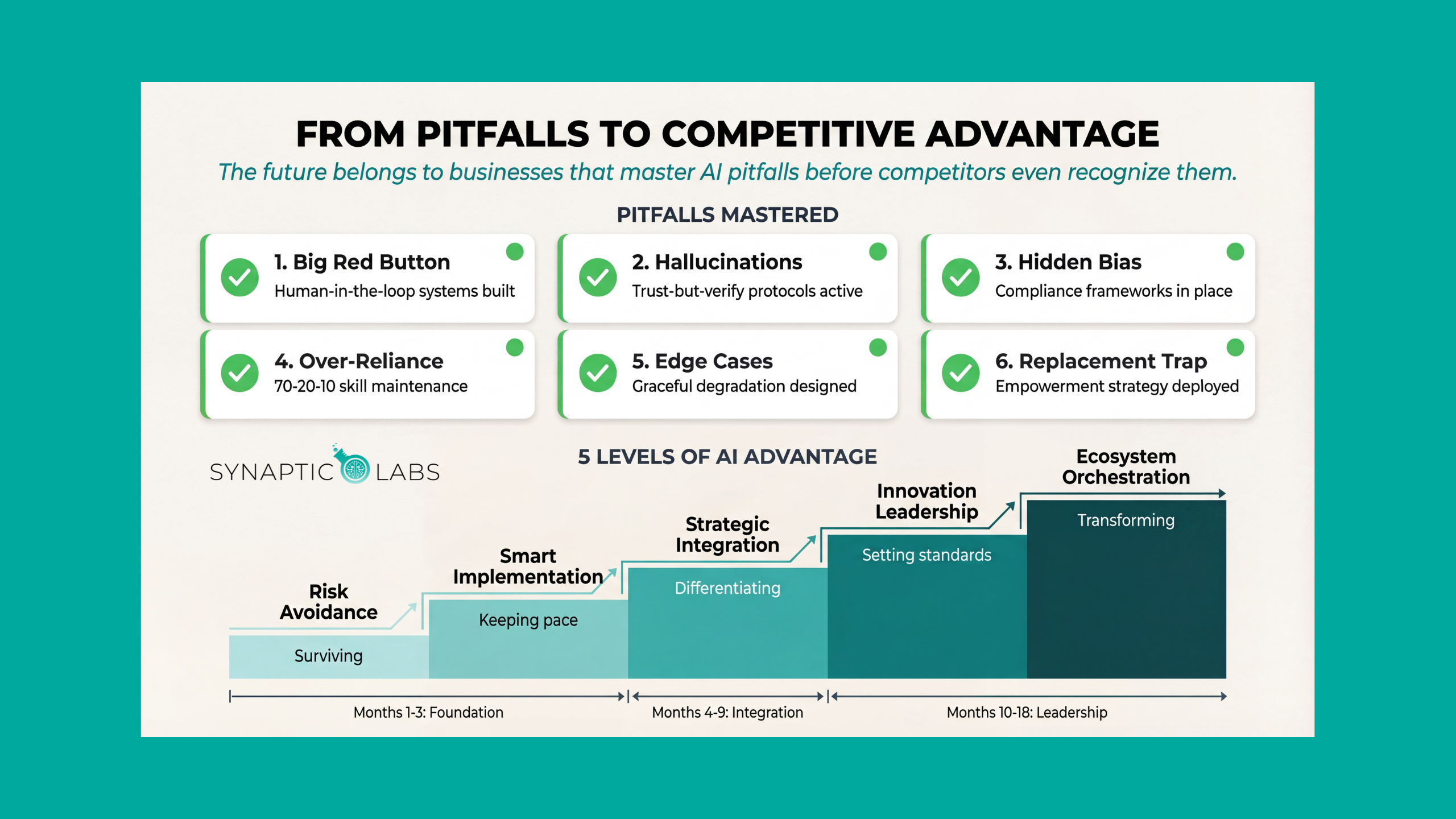
Level 1: Risk Avoidance (Survival) - Avoiding major AI failures through basic pitfall awareness. Defensive protection, cost savings from avoided disasters.
Level 2: Smart Implementation (Efficiency) - Implementing AI thoughtfully with proper systems. Productivity gains, process improvements, cost optimization.
Level 3: Strategic Integration (Advantage) - AI woven into business strategy with organizational capability building. New capabilities, revenue growth, clear differentiation.
Level 4: Innovation Leadership (Dominance) - Using AI to create new business models and market opportunities. Market disruption, industry leadership, exponential growth.
Level 5: Ecosystem Orchestration (Transformation) - Building AI-powered ecosystems that transform entire industries. Platform creation, legacy disruption, defining the future.
Synaptic Labs AI education attribution requiredYour Strategic Implementation Roadmap
Phase 1: Foundation Building (Months 1-3)
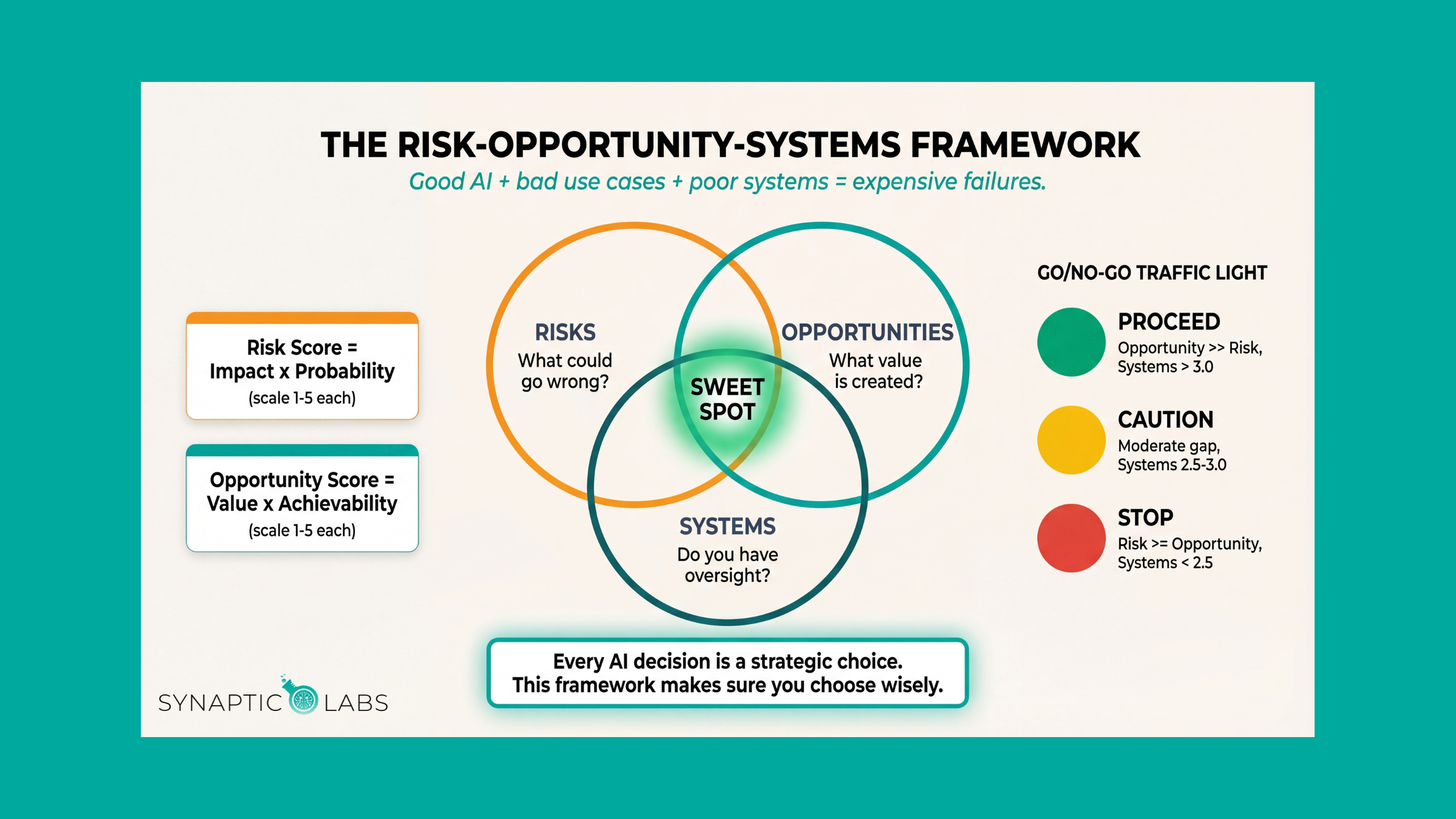
Establish pitfall prevention systems: hallucination detection, bias monitoring, human oversight procedures, edge case testing. Build decision-making discipline with the Risk-Opportunity-Systems framework. Create organizational readiness through AI literacy training and governance structures.
Phase 2: Strategic Integration (Months 4-9)
Scale successful implementations across the organization. Advance human-AI collaboration with team empowerment strategies. Develop competitive differentiation through unique AI applications and superior customer experiences.
Phase 3: Market Leadership (Months 10-18)
Create new AI-enabled products and services. Lead industry standards and share best practices. Build innovation momentum with experimental programs exploring emerging AI opportunities.
Building Organizational AI Maturity
Strategic Vision and Leadership: Clear AI strategy aligned with business objectives. Leadership that understands capabilities and limitations.
Operational Excellence and Systems: Robust human-AI collaboration processes. Systematic risk management and quality control.
Technical Capabilities: Appropriate infrastructure, data management, security, and integration capabilities.
Human Capital and Culture: AI-literate workforce. Culture that embraces collaboration rather than replacement. Innovation mindset.
Your Competitive Advantage Playbook
Superior Risk Management: While competitors deal with public failures and emergency fixes, you deliver reliable systems that build customer confidence through proactive monitoring and rapid response.
Faster Learning and Adaptation: While competitors trial-and-error through slow, expensive learning, you accelerate intelligently with systematic learning from each implementation.
Enhanced Human Capabilities: While competitors replace and struggle with lost expertise, you amplify with superhuman productivity from AI-empowered teams.
Customer Experience Leadership: While competitors create frustration with inconsistent AI, you delight and differentiate with seamless experiences that exceed expectations.
Want to know how ready your business is for AI? Take our free AI Readiness Assessment to find out where you stand. It takes just a few minutes, and you'll also get free access to one of our AI workflow templates to help you get started.
Your Next Actions
This Week: Assess your current competitive position on the five levels. Identify which pitfall mastery would create the most differentiation. Plan your strategic implementation roadmap.
This Month: Implement foundational risk management systems. Launch pilot programs leveraging pitfall knowledge. Build organizational AI literacy and collaboration skills.
This Quarter: Scale successful implementations. Measure and optimize your competitive position. Lead your industry with AI success stories and thought leadership.
The Bottom Line
AI pitfalls aren't obstacles to avoid. They're competitive intelligence that smart businesses use to build unbeatable advantages.
The companies that will dominate their industries aren't the ones with the best AI technology. They're the ones with the best implementation, the strongest risk management, and the most sophisticated human-AI collaboration.
The future belongs to businesses that master AI pitfalls before their competitors even recognize them.
Ready to transform AI pitfalls into sustainable competitive advantage? Partner with Synaptic Labs to build AI strategies that turn risks into opportunities and create lasting market leadership.
Want to see these pitfalls explained in detail? Watch our full walkthrough: What are the Common AI Pitfalls for Small Businesses?
Frequently Asked Questions
How do AI pitfalls become competitive advantages?
Most businesses learn about AI pitfalls the hard way: through public failures, expensive mistakes, and customer trust erosion. By understanding pitfalls upfront, you can move faster (because you're prepared for problems), build better (because you design with risks in mind), scale smarter (because your systems are resilient), and compete effectively while others deal with disasters. Each pitfall you master becomes a sustainable advantage that compounds over time.
What's the most important first step toward AI competitive advantage?
Build your foundation by implementing basic pitfall prevention systems: hallucination detection, bias monitoring, human oversight procedures, and edge case testing. This Level 1 (Risk Avoidance) capability protects you from the disasters that derail competitors and creates the stable base for advancing to higher levels of AI maturity. Most businesses skip this step and pay for it later.
How long does it take to build real AI competitive advantage?
The roadmap has three phases. Months 1-3 focus on foundation building (pitfall prevention, decision-making frameworks, organizational readiness). Months 4-9 cover strategic integration (scaling successful implementations, team empowerment, competitive differentiation). Months 10-18 target market leadership (new value propositions, industry standards, innovation momentum). Meaningful differentiation starts appearing by month 4-6, with sustainable competitive advantage emerging around month 10.
Can small businesses achieve AI competitive advantage against larger competitors?
Absolutely. Small businesses have natural advantages in AI implementation: faster decision-making, less organizational inertia, closer customer relationships, and the ability to iterate quickly. While large companies struggle with AI governance across thousands of employees, small businesses can implement thoughtful human-AI systems across their entire team in weeks. The framework scales to any size, and agility often matters more than budget.
Where should I start if my business has no AI strategy at all?
Start with the AI Readiness Assessment to understand your current position. Then pick one specific, low-risk use case (content drafting, research, data analysis) and implement it using the Risk-Opportunity-Systems framework. Build human oversight into the workflow from day one. Measure results, learn from the experience, and expand to the next use case. This incremental approach builds organizational capability while delivering immediate value. For structured prompts to guide your first AI implementations, visit our free Prompt Library.