
The Nonprofit Capacity Crisis: How AI Becomes Your Ultimate Force Multiplier

Professor Synapse
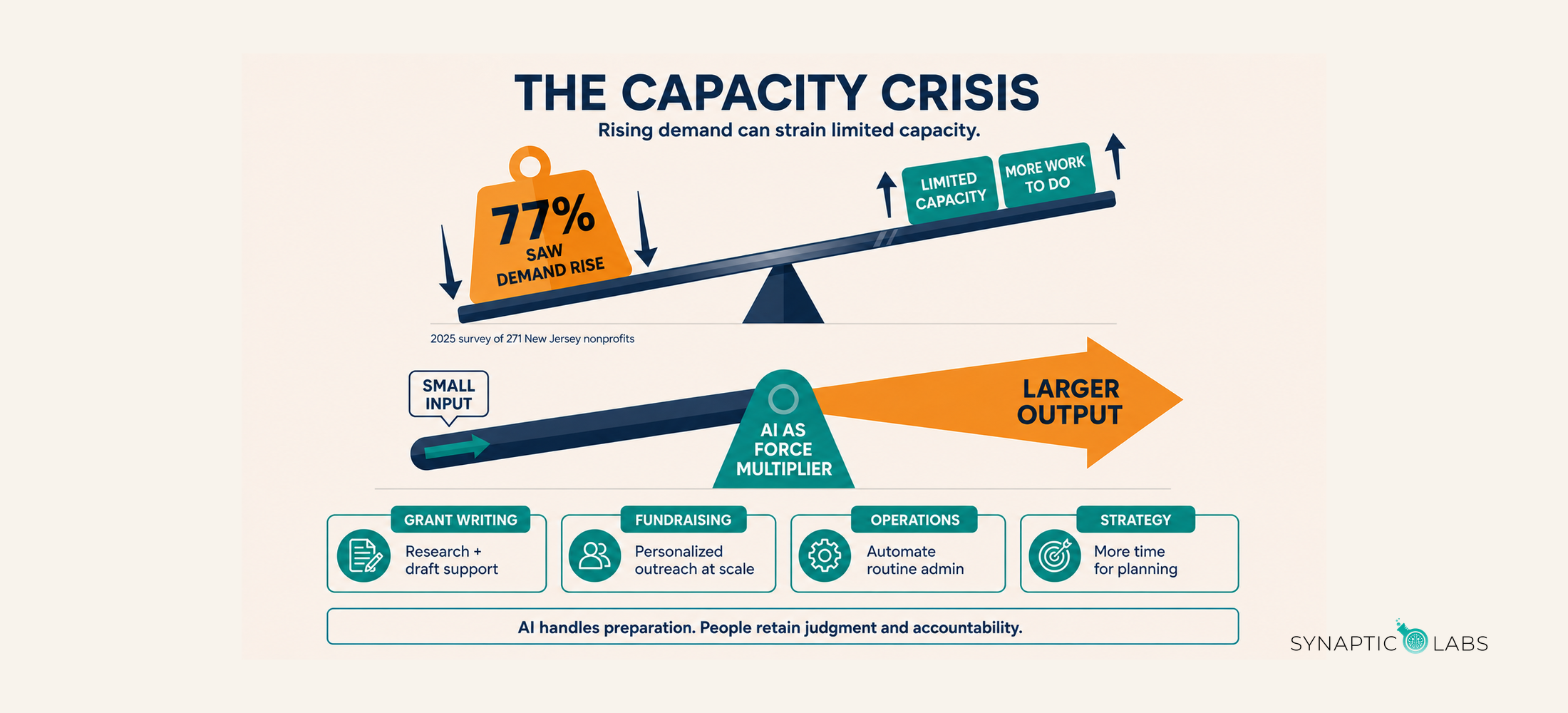
Nonprofit teams are being asked to absorb more demand without a matching increase in capacity.
The New Jersey Center for Nonprofits’ 2025 survey found that 77% of responding organizations experienced increased demand for services in 2024, while 52% reported increased overall funding. That is one state-level snapshot, not a universal national rate, but the mismatch will feel familiar to many nonprofit leaders.
The answer is not to push exhausted staff harder. It is to redesign work so people spend less time on repetitive preparation and more time on judgment, relationships, and service. That is nonprofit capacity building in the practical sense: not a grant line item, but more mission work per person per week.
AI can help. When it is treated as a carefully governed workflow tool rather than a promise of instant transformation.
Where AI Automation for Nonprofits Creates Capacity
Grant Development
AI can help organize funder research, compare guidelines with program information, outline a proposal, or turn approved source material into a first draft. A grant professional still verifies eligibility, selects evidence, shapes the case for support, and approves every claim.
The useful shift is from blank-page work to review-and-refine work. Measure the actual change in your process rather than relying on generic time-saving claims.
Fundraising and Communications
Development teams can use AI to draft message variants, organize donor notes, or identify patterns for human review. The technology should not invent personalization or make unsupported assumptions about a donor. It should help staff prepare for more thoughtful communication.
Operations
Meeting notes, recurring summaries, scheduling instructions, knowledge retrieval, and routine document preparation are often safer starting points than decisions that affect people’s rights or access to services. Teams asking how to use AI agents for nonprofit operations should start here, with bounded tasks a person can check, and with AI for internal communications before anything public facing.
The International Rescue Committee’s Signpost program shows what responsible scale can look like in a mission context. Signpost combines digital channels, community-centered information, human teams, and AI-supported systems to help people in crisis find trustworthy information across many countries and languages. The lesson is not that automation replaces the service; it is that technology can extend the reach of a carefully designed human operation.
Strategy
AI can help leaders explore scenarios, summarize program feedback, or spot patterns in data. It cannot decide what matters to the community. Strategic use still requires context, domain expertise, and accountability.
Synaptic Labs AI education attribution requiredA Better Definition of “Force Multiplier”
Calling AI a force multiplier should not imply that every tool automatically doubles output or eliminates workload. The effect depends on the process.
A useful pilot has:
- a specific workflow;
- an accountable owner;
- approved data boundaries;
- a human review step;
- a baseline for time and quality;
- a short evaluation period; and
- a clear stop condition.
If the tool adds rework, creates risk, or produces weak output, stop or redesign the pilot. Capacity only increases when the complete workflow improves.
Start With One Repetitive Task
Choose a task that is frequent, time-consuming, and easy to review. Good candidates include:
- turning meeting transcripts into draft action lists;
- converting approved program notes into a report outline;
- drafting routine email variations from verified information;
- organizing public funder requirements into a comparison table; or
- preparing social copy for human editing and approval.
For two weeks, track three things: minutes spent, corrections required, and whether staff could redirect saved time to mission work. Do not put sensitive constituent or donor information into a tool that has not passed your privacy and security review.
Capacity With Accountability
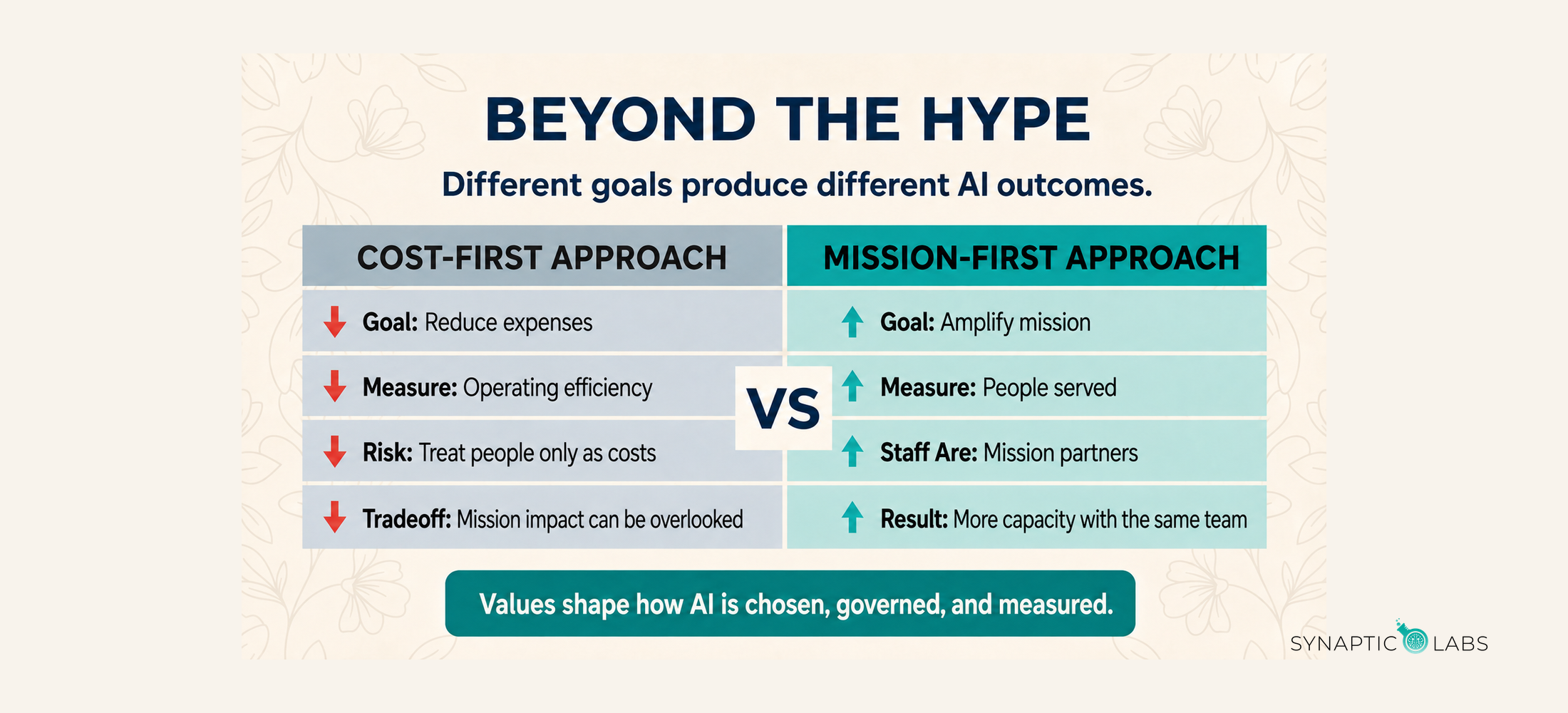
The goal is not to automate the human work that makes nonprofits trustworthy. It is to protect that work from the administrative load surrounding it.
AI can prepare. People decide. AI can organize. People interpret. AI can produce a first draft. People remain responsible for the truth, the tone, and the impact.
That is how a lean team turns technology into real capacity: not through heroic promises, but through one well-chosen workflow at a time.
Frequently Asked Questions
What is capacity building for nonprofits?
Capacity building is any investment that increases how much mission work an organization can do well: skills, systems, processes, and tools. Grants often fund it, but the outcome is the same either way. AI belongs in that conversation when it removes administrative load without removing human judgment.
How do you build capacity in a nonprofit organization with AI?
Pick one frequent, repetitive task, set a baseline for time and quality, and run a two-week pilot with a human review step. Track minutes saved, corrections required, and whether the time actually moved to mission work. Repeat with the next task only when the first one holds up.
How can AI help nonprofits do more with less?
By handling preparation, not decisions. AI can turn transcripts into draft action lists, organize funder requirements, and produce first drafts from approved material, while staff keep responsibility for accuracy, tone, and outcomes. The capacity gain comes from review-and-refine replacing blank-page work.
Ready to test your first capacity-building workflow? Get our free Nonprofit Flow Course.
Massachusetts nonprofits: You may be eligible for AI training and implementation support through our CommCorp grant program.
Need help selecting a safe first pilot? Contact the Synaptic Labs team.
