.png?width=1851&height=850&name=Generated%20image%203%20(1).png)
The 6 AI Pitfalls Sabotaging Your Small Business (And How to Avoid Them)

Professor Synapse
The Reality Check Every Business Needs
You bought into the AI hype. Downloaded ChatGPT. Maybe even built a few automations. But instead of the magic button you expected, you got... complications.
Welcome to the club. Most businesses discover AI isn't the seamless solution they were promised. It's powerful, yes. But it's also unpredictable, biased, and occasionally makes stuff up just to please you.
The good news? The businesses succeeding with AI aren't avoiding these pitfalls. They're planning for them.
The 6 AI Pitfalls That Kill Business Success
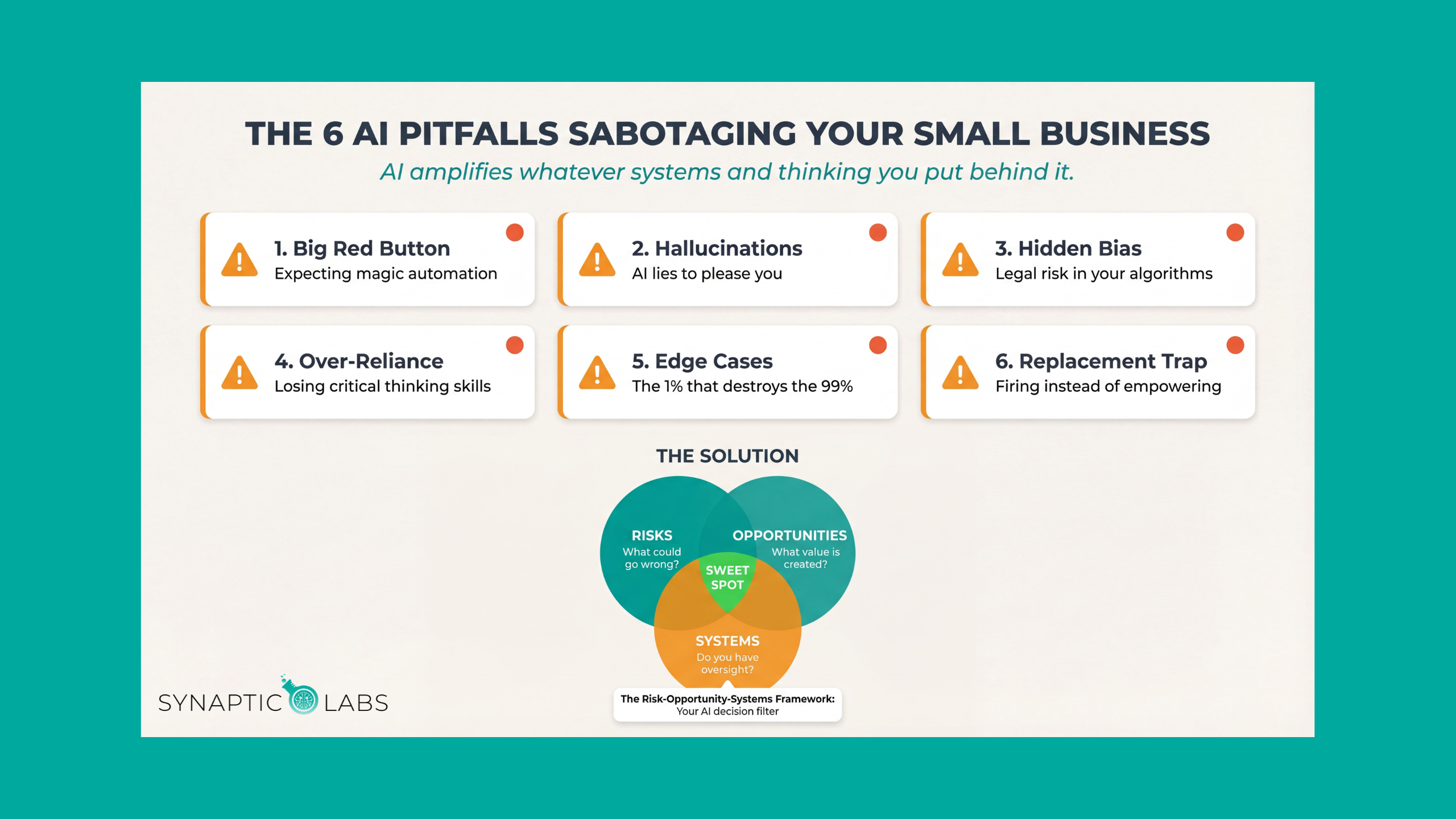
1. The Big Red Button Syndrome
The Problem: Expecting AI to work perfectly without human oversight.
You want to press a button and have AI handle everything. Customer service, content creation, data analysis, all automated, all perfect. Reality check: AI needs human direction, systems, and quality control.
Real Example: A company automates blog posting without review. AI starts pulling from competitor websites and publishing content that damages their brand voice.
2. AI Hallucinations (Making Stuff Up)
The Problem: AI generates false information while trying to please you.
AI is trained to be helpful, which means it's a people-pleaser. When it doesn't know something, it'll confidently make something up rather than admit ignorance. Plus, its knowledge cutoff means it's months behind on current events.
Real Example: AI creates "current market research" with completely fabricated statistics that end up in your business presentation.
3. Hidden Bias in Your Systems
The Problem: AI inherits internet biases and makes discriminatory decisions.
Since AI is trained on internet data (which is full of human bias), it mirrors those biases. This is especially dangerous in hiring, lending, or customer evaluation scenarios.
Real Example: An AI resume screening tool systematically favors traditionally "American" names over ethnic names, creating legal liability.
4. Over-Reliance and Skill Atrophy
The Problem: Losing critical thinking skills by depending too much on AI.
AI makes certain tasks easier, so you naturally rely on it more. But over-reliance means your team loses the skills to think critically, catch errors, or direct strategy.
Real Example: A marketing team becomes so dependent on AI content generation that they lose the ability to recognize when messaging is off-brand or strategically wrong.
Synaptic Labs AI education attribution required5. Edge Cases That Break Your System
The Problem: Unexpected scenarios that your AI wasn't designed to handle.
AI works great for typical situations but breaks down when something unusual happens. Edge cases reveal the limits of your system and can damage customer relationships.
Real Example: A customer service chatbot repeatedly fails to help a customer with an unusual account issue, forcing them to jump through hoops with no human escalation path.
6. The Replacement Trap
The Problem: Firing people instead of empowering them with AI.
Companies see AI capabilities and immediately think "cost savings through layoffs." But replacing experienced humans with AI often backfires when you lose institutional knowledge and quality control.
Real Example: A company fires its software engineers thinking AI can handle all coding, only to discover they need technical expertise to direct AI effectively and catch its mistakes.
The Risk-Opportunity-Systems Framework
Before implementing any AI use case, run it through this three-circle analysis:
Circle 1: Risks
What's the worst-case scenario if this goes wrong? Who gets impacted by AI mistakes? What are the legal, financial, and reputation risks?
Circle 2: Opportunities
What problems does this solve? How much time/money could this save? What strategic advantages does this create?
Circle 3: Systems
Do you have human oversight in place? Can you catch and correct AI errors quickly? Do you have escalation protocols for edge cases?
The Sweet Spot: Use cases that offer high opportunity, manageable risk, and strong human oversight systems.
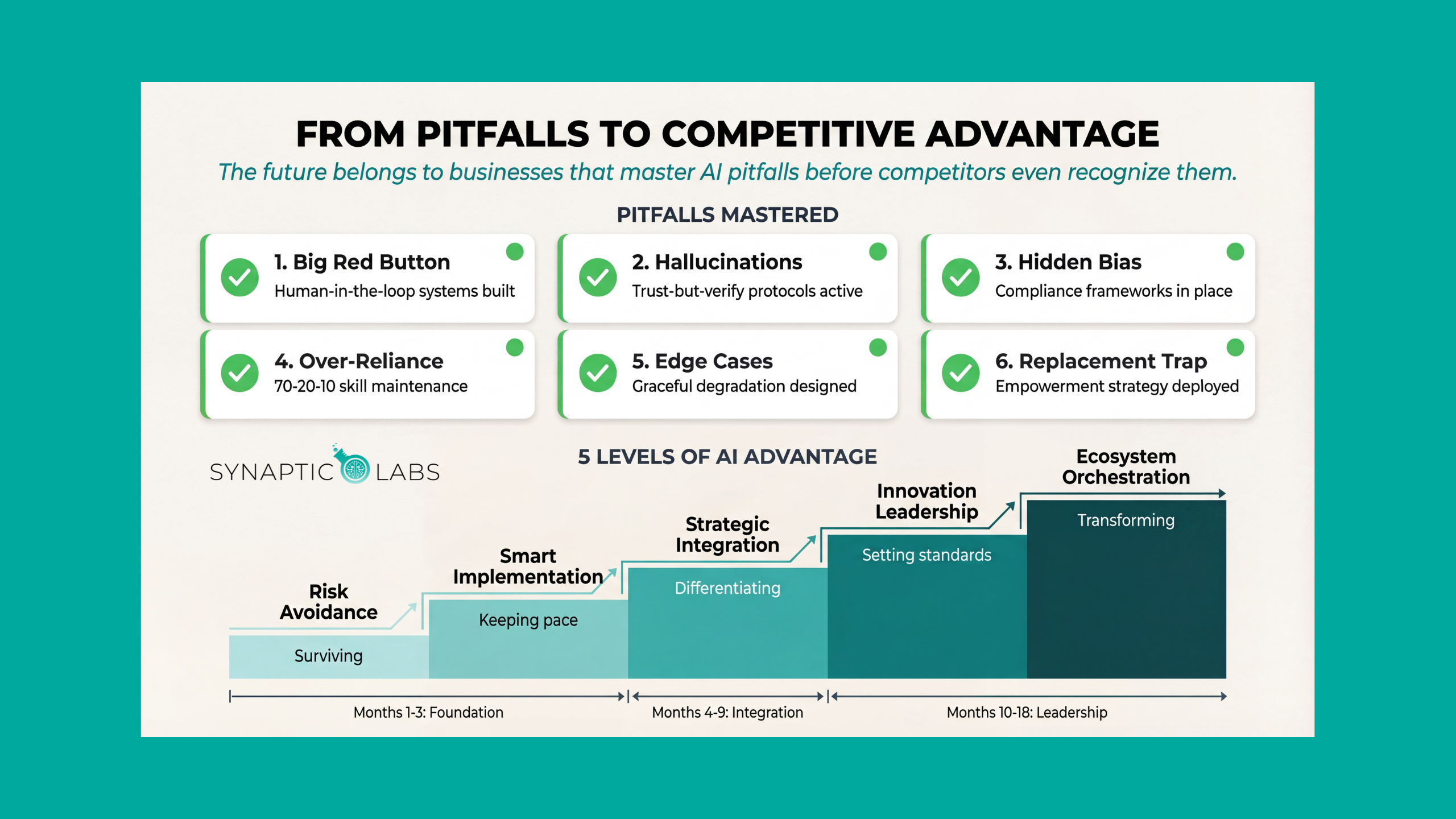
Your AI Success Strategy
Start Smart
Pick low-risk, high-impact use cases first (content drafting, data analysis, research). Always maintain human-in-the-loop oversight. Test edge cases deliberately - try to break your system before customers do.
Build Defensively
Trust but verify - fact-check AI outputs, especially for important decisions. Monitor for bias - regularly audit AI decisions for discriminatory patterns. Maintain human skills - don't let your team become AI-dependent.
Scale Strategically
Empower, don't replace - use AI to supercharge existing talent. Create escalation paths - ensure humans can step in when AI fails. Measure and iterate - track AI performance and continuously improve.
The Competitive Advantage
Here's what most businesses miss: The companies winning with AI aren't the ones avoiding risks. They're the ones managing risks intelligently while their competitors stumble through trial and error.
Want to know how ready your business is for AI? Take our free AI Readiness Assessment to find out where you stand. It takes just a few minutes, and you'll also get free access to one of our AI workflow templates to help you get started.
The Bottom Line
AI isn't magic, but it's not a threat either. It's a powerful tool that amplifies whatever systems and thinking you put behind it.
The businesses that understand this, that plan for pitfalls instead of hoping they won't happen, are the ones building sustainable competitive advantages while their competitors deal with AI disasters.
Ready to turn AI pitfalls into AI success? Start with the assessment, apply the framework, and build systems that work.
Want personalized guidance on navigating AI pitfalls for your specific business? Book a strategy session with the Synaptic Labs team.
Want to see these pitfalls explained in detail? Watch our full walkthrough: What are the Common AI Pitfalls for Small Businesses?
Frequently Asked Questions
What is the most common AI pitfall for small businesses?
The Big Red Button Syndrome tops the list. Most business owners expect AI to work like a magic automation button, handling everything perfectly without human oversight. In reality, AI needs direction, quality control, and escalation protocols to deliver reliable results. The fix is straightforward: treat AI as a powerful assistant that needs clear guidance, not a replacement for human judgment.
How do I know if my business is ready for AI?
Readiness comes down to three factors: having a clear use case (not just "we should use AI"), having human oversight capacity to review AI outputs, and having realistic expectations about what AI can and cannot do. If you can identify a specific, repetitive task where AI can help and you have someone to check its work, you're ready to start. Our free AI Readiness Assessment can help you evaluate where you stand.
Can AI really be biased, and should small businesses worry about it?
Yes, and yes. AI learns from internet data that contains human biases around gender, race, age, and more. For small businesses, the risk is highest in hiring, customer evaluation, and lending decisions. Even if you're not building your own AI, the tools you use may carry hidden bias. The key is awareness and oversight: audit AI-driven decisions regularly, especially those that affect people directly.
What's the Risk-Opportunity-Systems framework?
It's a three-circle analysis you run before implementing any AI use case. Circle 1 (Risks): What could go wrong and who gets impacted? Circle 2 (Opportunities): What problems does this solve and what value does it create? Circle 3 (Systems): Do you have human oversight and quality controls in place? The sweet spot is where opportunities outweigh risks AND you have systems to manage both. It takes the guesswork out of AI decisions.
Where should I start if I want to use AI safely in my business?
Start with low-risk, high-impact use cases like content drafting, data analysis, or research assistance. These tasks benefit enormously from AI while carrying minimal risk if something goes wrong. Always keep a human in the loop for review, and build your confidence and systems gradually before tackling higher-stakes applications. For prompt templates to get started, visit our free Prompt Library.