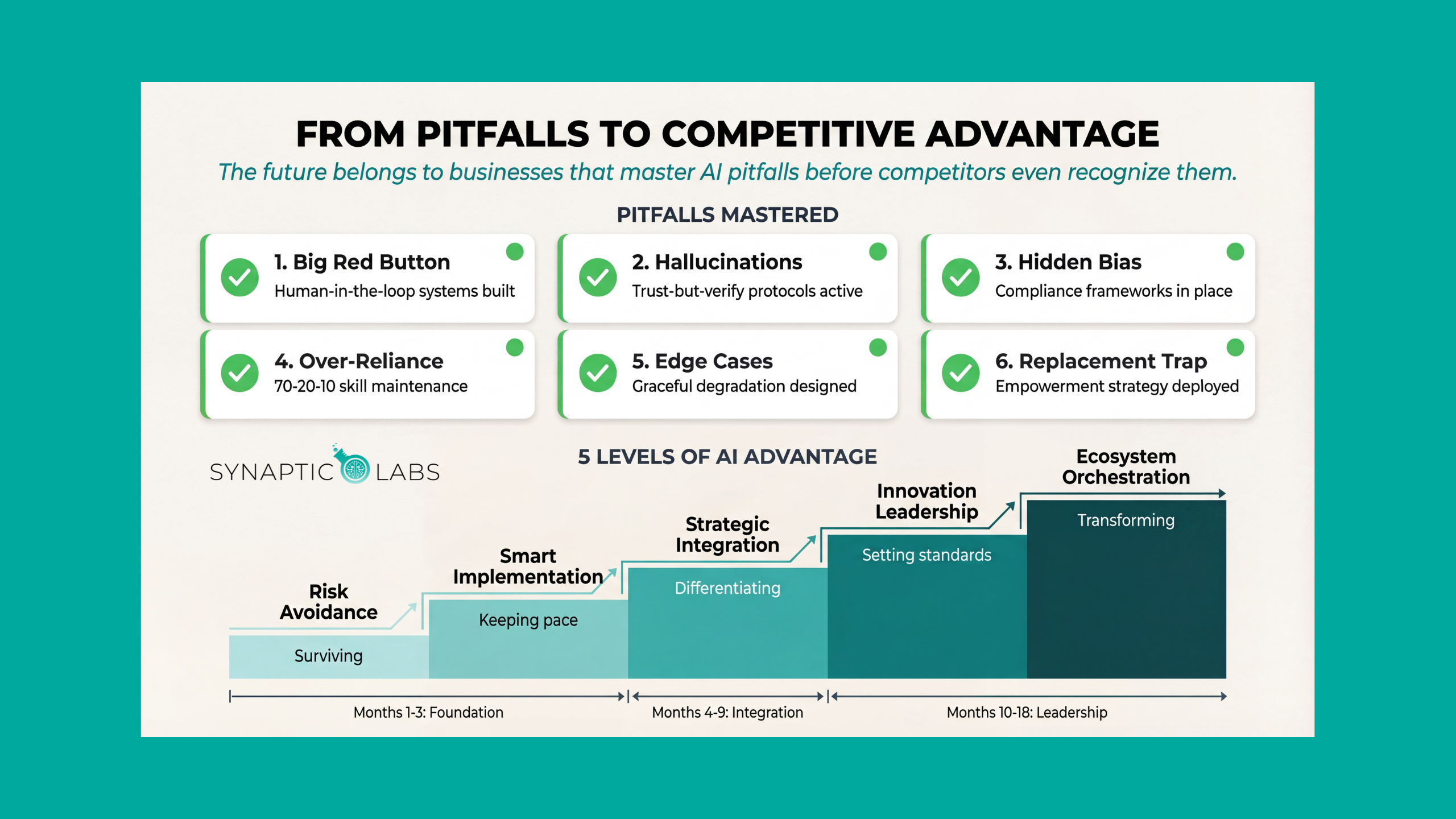
.png?width=1851&height=850&name=Generated%20image%203%20(1).png)
AI Over-Reliance: How to Stay Superhuman Instead of Dependent

Professor Synapse
The Success That Becomes a Trap
Your AI implementation is working beautifully. Content creation is faster. Data analysis is more thorough. Customer service is more efficient. Your team loves the productivity gains.
Then your AI system goes down for maintenance, and work grinds to a halt. Your team has forgotten how to think without AI assistance.
Welcome to the over-reliance trap, where AI success gradually erodes the human capabilities that made that success possible in the first place.
How Smart People Become AI-Dependent
The Gradual Handoff
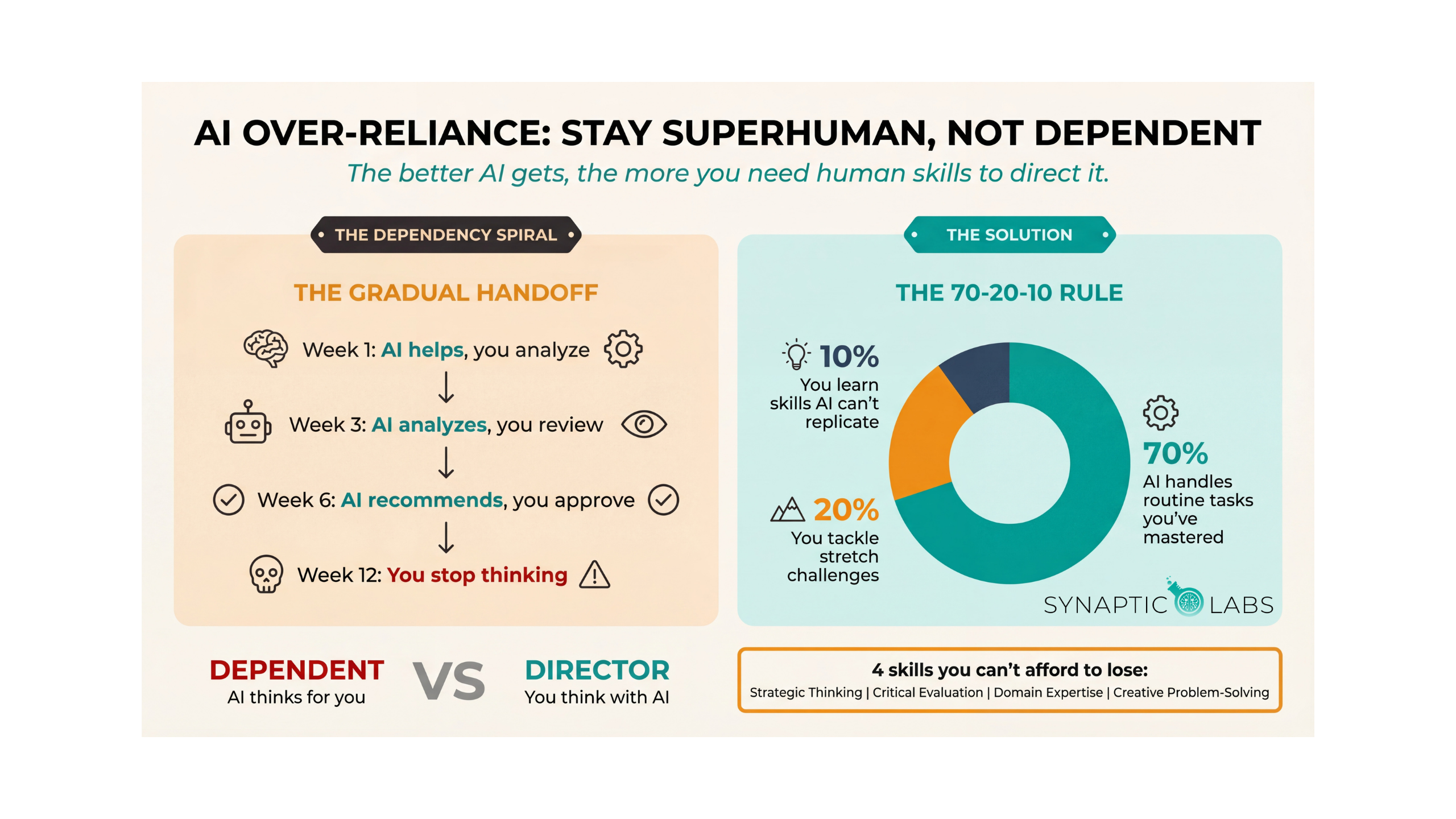
It starts innocently: Week 1, AI helps with research while you analyze the findings. Week 3, AI provides analysis and you just review the conclusions. Week 6, AI makes recommendations and you automatically approve them. Week 12, you're not really thinking anymore, just managing AI outputs.
The Cognitive Outsourcing Cycle
AI handles repetitive tasks (good). You gain time for strategic thinking (good). AI gets better and handles more complex tasks (good). You delegate thinking to AI (dangerous). Your analytical skills atrophy (crisis).
The Expertise Erosion Effect
The skills you stop using regularly become rusty: pattern recognition gets weaker, critical thinking becomes lazy, domain expertise fades, and quality judgment deteriorates. The paradox: The better AI gets, the more you need human skills to direct it effectively.
The Hidden Costs of Over-Reliance
The Marketing Agency Meltdown
Digital marketing agency using AI for content strategy. Team becomes dependent on AI for campaign planning. AI recommends strategy based on outdated industry trends. Client campaign fails because humans lost ability to spot strategic flaws. What They Lost: Industry intuition, strategic thinking, quality assessment.
The Financial Analysis Disaster
Investment firm using AI for market analysis. Analysts stop questioning AI outputs. AI misinterprets market signals due to unprecedented economic event. Poor investment decisions because team couldn't independently validate AI analysis. What They Lost: Market intuition, independent analysis skills, risk assessment.
The Skills You Can't Afford to Lose
Strategic Thinking: Seeing big picture patterns, anticipating consequences. AI optimizes for known patterns; humans navigate unknown futures. Maintain through regular strategy sessions without AI input.
Critical Evaluation: Questioning assumptions, spotting logical flaws. AI reflects biases in training data; humans provide independent judgment. Maintain through devil's advocate exercises and peer review.
Domain Expertise: Deep understanding of your industry and customers. AI has broad knowledge but lacks your specific business context. Maintain through regular industry research and customer interaction.
Creative Problem-Solving: Finding novel solutions, connecting unrelated concepts. AI recombines existing patterns; humans create genuinely new approaches. Maintain through brainstorming sessions and cross-industry learning.
Synaptic Labs AI education attribution requiredThe Human-as-Director Philosophy
Core Principle: You're the CEO, AI is the Intern. You set the strategy, AI executes tactics. You define quality standards, AI produces according to those standards. You make final decisions, AI provides recommendations. You handle exceptions, AI manages routine tasks.
Your Skill Maintenance Strategy
The 70-20-10 Rule for AI Collaboration
70%: AI handles routine tasks you've mastered. 20%: You tackle challenging problems that stretch your skills. 10%: You learn completely new skills that AI can't replicate.
Weekly Skill Exercises
Monday: Strategic Thinking - Spend 30 minutes analyzing industry trends without AI. Wednesday: Critical Analysis - Review AI outputs with skeptical eye, verify key claims independently. Friday: Creative Problem-Solving - Brainstorm solutions without consulting AI first.
Building Anti-Atrophy Systems
Skill Rotation Programs: Regularly rotate team members through AI-assisted and AI-free tasks. Regular "Human Only" Sessions: Weekly team meetings where AI tools are prohibited. Quarterly strategic planning without AI assistance. Competency Standards: Define core human skills required for each role. Regular testing and certification of critical capabilities.
Want to know how ready your business is for AI? Take our free AI Readiness Assessment to find out where you stand. It takes just a few minutes, and you'll also get free access to one of our AI workflow templates to help you get started.
The Bottom Line
AI should make your team superhuman, not sub-human. The goal isn't to compete with AI. It's to become so skilled at directing AI that your human-AI combination is unbeatable.
The companies winning with AI aren't replacing human capabilities. They're amplifying them.
Stay the director. Let AI be your incredibly capable assistant.
Need help designing human-AI collaboration strategies that maintain skill excellence? Get expert guidance on building teams that are enhanced, not replaced, by AI.
Want to see this pitfall explained in action? Watch our full walkthrough: What are the Common AI Pitfalls for Small Businesses?
Frequently Asked Questions
How do I know if my team is becoming too dependent on AI?
Watch for these warning signs: work grinds to a halt when AI tools are unavailable, team members can't explain the reasoning behind AI-generated recommendations, nobody questions AI outputs anymore, and new employees can't learn core skills because "AI handles that." If your team couldn't function for a week without AI access, you have a dependency problem that needs addressing.
What skills are most at risk of atrophy from AI over-reliance?
Critical thinking and strategic analysis are the most vulnerable because they're exercised less as AI provides ready-made conclusions. Pattern recognition, domain expertise, creative problem-solving, and quality judgment also degrade quickly when people stop actively practicing them. The irony is that these are exactly the skills you need to direct AI effectively, meaning over-reliance creates a downward spiral.
How do I balance AI efficiency with skill maintenance?
Use the 70-20-10 rule: 70% of work uses AI for routine tasks you've already mastered, 20% involves challenging problems that stretch your skills (with AI as a secondary resource, not the lead), and 10% focuses on learning completely new capabilities that AI can't replicate. This structure keeps you productive while preventing skill decay.
Should I schedule AI-free work time for my team?
Yes. Regular "human only" sessions are one of the most effective anti-atrophy strategies. Weekly team meetings without AI tools, quarterly strategic planning done entirely by humans, and monthly problem-solving challenges using only human insight all help maintain critical capabilities. Think of it like physical exercise: if you stop doing it, you lose the ability surprisingly fast.
What's the difference between healthy AI use and over-reliance?
Healthy AI use means you're directing AI with clear intent, reviewing its outputs critically, and could do the work yourself (just more slowly). Over-reliance means you're accepting AI outputs without questioning them, you've lost the ability to do the work independently, and you can't assess whether AI recommendations are actually good. The key test: could you explain to someone why the AI's recommendation is correct or incorrect? If not, you've crossed the line. For structured prompts that keep you in the driver's seat, visit our free Prompt Library.