.png?width=1851&height=850&name=Generated%20image%203%20(1).png)
Hidden AI Bias: The Legal Risks Lurking in Your Business Decisions

Professor Synapse
The Lawsuit You Didn't See Coming
Your AI resume screening tool is working great. It's filtering applications efficiently, and your hiring manager loves the time savings. Then you get sued for discrimination.
The investigation reveals your AI consistently favors traditionally "American" names over ethnic names. Same qualifications, different outcomes based on something that should be irrelevant: what someone's parents decided to call them.
Welcome to AI bias, the silent business killer that turns helpful tools into legal nightmares.
Why AI Bias Isn't Optional. It's Inevitable
The Internet Training Problem
AI learns from internet data, which is full of human bias. When AI studies millions of text examples, it absorbs patterns that reflect society's prejudices: gender stereotypes about job roles, racial assumptions about creditworthiness, age discrimination in hiring decisions, and geographic bias about intelligence or work ethic.
The Mirror Effect
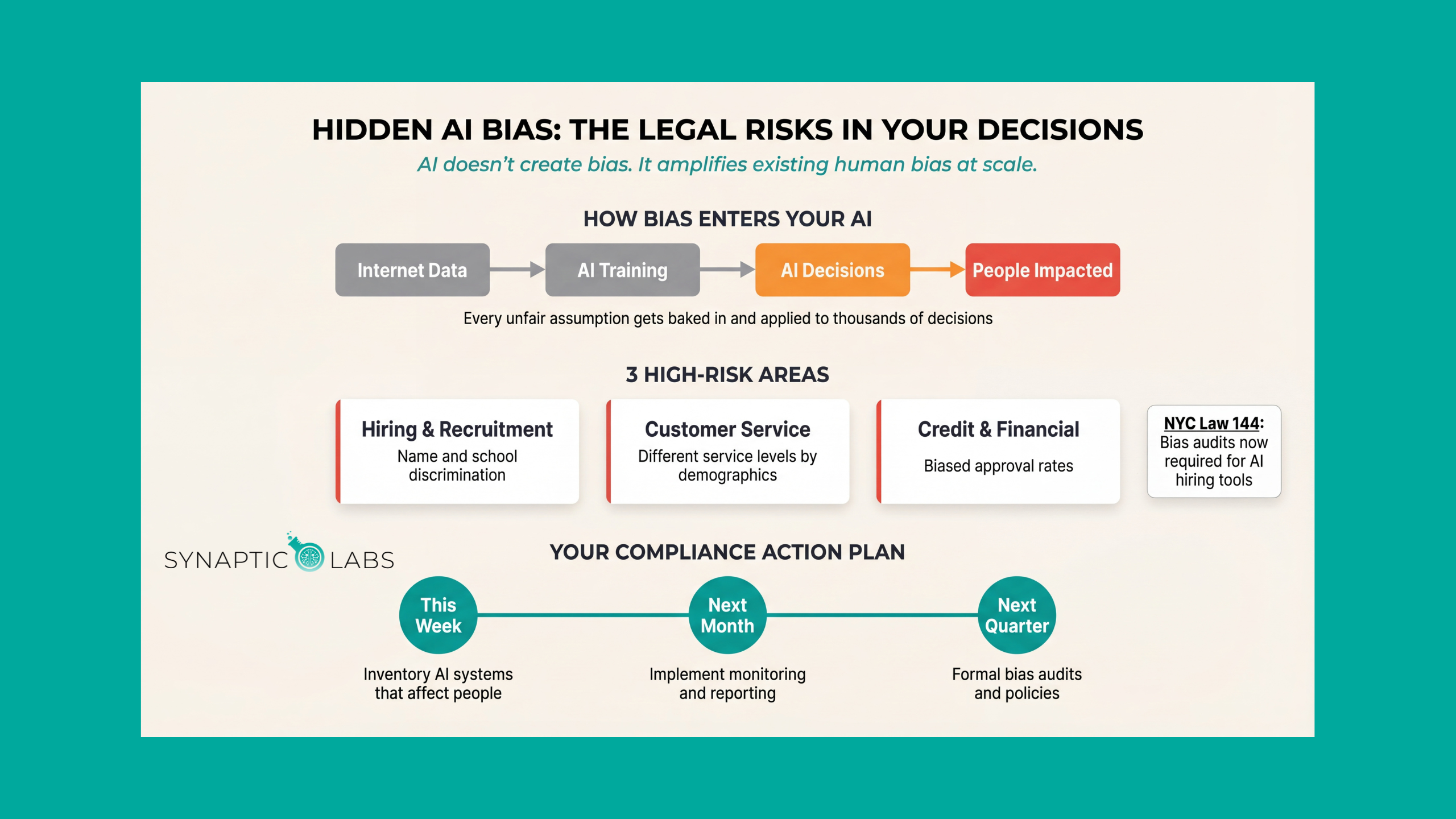
AI doesn't create bias. It amplifies existing human bias at scale. Every unfair assumption lurking in training data gets baked into the system and applied to thousands of decisions.
The dangerous part: AI bias feels objective because it's algorithmic. People trust computer decisions more than human decisions, even when the computer learned from biased humans.
Where AI Bias Hits Your Business
Hiring and Recruitment
The Risk: AI resume screening that discriminates based on names, schools, or coded language. Real Example: Amazon scrapped an AI recruiting tool that systematically downgraded women's resumes. Legal Exposure: EEOC violations, discrimination lawsuits, reputation damage.
Customer Service and Support
The Risk: AI chatbots providing different service levels based on perceived customer characteristics. Real Example: AI systems providing different insurance quotes based on zip codes that correlate with race. Legal Exposure: Civil rights violations, consumer protection lawsuits.
Credit and Financial Decisions
The Risk: AI making lending or credit decisions that disproportionately impact protected groups. Real Example: Mortgage algorithms showing racial bias in approval rates. Legal Exposure: Fair Housing Act violations, CFPB enforcement actions.
Synaptic Labs AI education attribution requiredThe Legal Landscape You Need to Know
Key regulations include: EEOC (hiring and workplace AI), Fair Housing Act (real estate and lending AI), CFPB (financial services AI), and ADA (accessibility in AI systems). Recent enforcement actions include NYC Local Law 144 requiring bias audits for AI hiring tools, EEOC guidance on AI discrimination, FTC warnings about AI bias in consumer applications, and state-level AI accountability legislation. The trend is clear: regulators are getting serious, and the penalties are getting real.
Your AI Bias Detection Framework
Pre-Implementation Testing
Demographic Impact Analysis: Run identical scenarios with different demographic indicators. Compare outcomes by race, gender, age, disability status. Look for statistically significant disparities.
Historical Bias Audit: Analyze past human decisions for bias patterns. Don't train AI on biased historical outcomes. Clean or reweight training data to reduce bias.
Edge Case Testing: Test with names from different cultural backgrounds, addresses from various socioeconomic areas, educational backgrounds beyond traditional paths, and career gaps that might correlate with protected characteristics.
Ongoing Monitoring
Monthly review of AI decisions tracking selection/approval rates by demographic groups, monitoring for emerging bias patterns, and comparing AI decisions to human baseline decisions. Create channels for bias reporting and schedule annual third-party bias assessments.
Your Compliance Action Plan
This Week: Inventory your AI systems that make decisions about people. Assess legal risk for protected characteristics. Review current safeguards.
Next Month: Implement basic monitoring tracking outcomes by demographic groups. Create bias reporting channels. Train your team on AI bias recognition.
Next Quarter: Conduct formal bias audits across all AI systems. Develop compliance policies. Establish regular review cycles.
Want to know how ready your business is for AI? Take our free AI Readiness Assessment to find out where you stand. It takes just a few minutes, and you'll also get free access to one of our AI workflow templates to help you get started.
The Bottom Line
AI bias isn't a technical problem you can solve with better algorithms. It's a business risk you manage with better processes, monitoring, and safeguards.
The companies succeeding with AI aren't the ones with bias-free systems (that's impossible). They're the ones with robust bias detection, mitigation, and response systems.
Remember: The most expensive lawsuit is the one you didn't see coming. Plan for bias now.
Need help building bias-resistant AI systems and compliance frameworks? Get expert guidance on implementing responsible AI practices that protect your business.
Want to see this pitfall explained in action? Watch our full walkthrough: What are the Common AI Pitfalls for Small Businesses?
Frequently Asked Questions
How does AI become biased in the first place?
AI learns from internet data, which reflects decades of human bias around gender, race, age, geography, and more. When AI processes millions of text examples, it absorbs patterns that mirror society's prejudices. For instance, if historical hiring data shows a preference for certain demographics, AI trained on that data will replicate those preferences. AI doesn't create new bias; it amplifies existing human bias at scale and applies it consistently across thousands of decisions.
Is AI bias only a problem for large companies?
No. Any business using AI for decisions that affect people faces bias risk. If you use AI to screen resumes, evaluate customers, set pricing, or generate marketing content, bias can creep in. Small businesses often face more risk because they have fewer resources to detect and correct bias, and a single discrimination lawsuit can be devastating. The good news is that basic bias monitoring (tracking outcomes across demographic groups) doesn't require enterprise-level resources.
What laws govern AI bias in business?
The regulatory landscape is evolving quickly. The EEOC covers AI in hiring, the Fair Housing Act covers AI in lending and real estate, and the CFPB addresses AI in financial services. NYC Local Law 144 already requires bias audits for AI hiring tools, and similar state-level legislation is spreading. The trend is clear: regulators are getting serious, and penalties are getting real. Staying ahead of compliance is far cheaper than reacting to enforcement actions.
How do I test my AI tools for bias?
Start simple: run identical scenarios through your AI with different demographic indicators (names, locations, ages) and compare outcomes. If your AI screening tool produces different results for equivalent qualifications based on the applicant's name, you have a bias problem. For deeper analysis, track selection and approval rates by demographic groups over time. Annual third-party bias audits provide the most comprehensive assessment, but monthly outcome analysis catches most issues early.
What should I do if I discover bias in my AI systems?
First, document the finding and assess the scope of impact. Second, implement immediate human review for any decisions the biased system has been making. Third, investigate the root cause (training data, feature selection, or model design). Fourth, correct the issue and re-test before returning the system to production. Finally, create ongoing monitoring to prevent recurrence. For structured approaches to managing AI workflows responsibly, visit our free Prompt Library.