.png?width=1851&height=850&name=Generated%20image%203%20(1).png)
AI Edge Cases: Find System Failures Before Your Customers Do

Professor Synapse
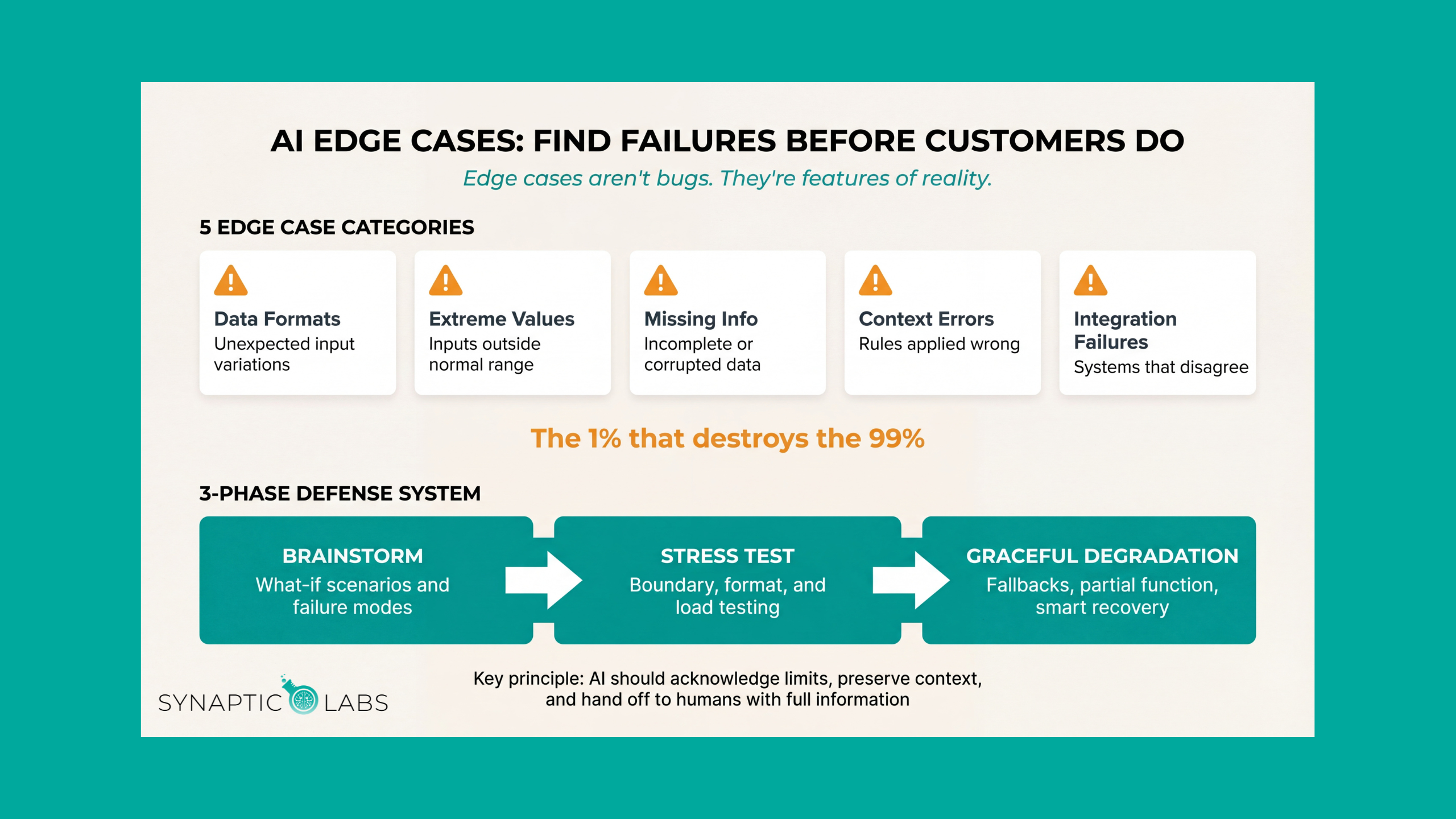
The 1% That Destroys the 99%
Your AI customer service bot handles 99% of inquiries perfectly. Response times are fast, accuracy is high, customer satisfaction is up. Then someone asks about a refund for a product they bought using a discontinued coupon during a brief website glitch, and your bot goes haywire.
It gives conflicting information, creates an infinite loop of unhelpful responses, and eventually tells the frustrated customer that their problem "doesn't exist." The customer posts the conversation on social media, and suddenly your AI success story becomes a viral customer service disaster.
Welcome to edge cases, the unexpected scenarios that expose the boundaries of your AI systems in the most public, embarrassing ways possible.
What Are Edge Cases and Why They Matter
Edge cases are scenarios your AI wasn't designed or trained to handle: unusual combinations of inputs, data outside the expected range, situations not covered in training data, and interactions that break system assumptions.
They're dangerous because they produce unpredictable outputs, can cause complete system failures, damage customer relationships, and trigger cascade effects where one failure creates multiple problems. Edge cases are rare by definition, which makes them easy to ignore. But when they happen, they're often public, embarrassing, and cause disproportionate damage.
Common AI Edge Case Categories
1. Data Format Variations: AI expects data in specific formats but receives unexpected variations. Customer names with special characters, phone numbers in international formats, addresses that don't match standard postal formatting.
2. Extreme Values: AI receives inputs far outside its training range. Financial calculations with unusually large or small numbers, product quantities of 10,000 units in a shopping cart.
3. Missing or Corrupted Information: AI assumes certain data will always be available and complete. Customer profiles missing key information, product descriptions with incomplete specifications.
4. Contextual Misunderstandings: AI misinterprets context or applies rules inappropriately. Seasonal policies applied at wrong times, regional rules applied to wrong areas.
5. Multi-System Integration Failures: AI works fine individually but breaks when interacting with other systems. Data sync delays, API timeouts during high traffic, version conflicts between AI components.
Synaptic Labs AI education attribution requiredYour Edge Case Detection Strategy
Phase 1: Brainstorm Failure Scenarios
Systematically consider unusual scenarios: What if someone enters maximum possible values in every field? What if a customer has the same first and last name? What if someone tries to schedule a meeting for yesterday? Review past human-handled exceptions and research AI failures at other companies.
Phase 2: Systematic Stress Testing
Boundary Testing: Test maximum and minimum values for all inputs. Try every combination of optional fields. Format Variation Testing: Test different date formats, special characters, emojis, mixed languages. Volume and Load Testing: Simulate high-traffic scenarios, concurrent usage, rapid-fire requests.
Phase 3: Adversarial Testing
Test how AI responds to users trying to break it: deliberately confusing instructions, attempts to extract sensitive information, social engineering attempts against AI systems.
Building Edge Case Resilience
Graceful Degradation Design
Fallback Procedures: Clear escalation to human oversight when AI can't handle a situation. Partial Functionality: Provide reduced but working functionality instead of complete failure. Smart Error Recovery: Automatic retry mechanisms, data correction suggestions, learning from edge cases.
The Escalation Protocol
1. Immediate recognition: AI identifies when it's outside normal parameters. 2. Graceful handoff: Transfer to human oversight with context preservation. 3. Documentation: Record edge case details for system improvement. 4. Resolution tracking: Monitor how edge cases are resolved. 5. System learning: Update AI based on human edge case handling.
Want to know how ready your business is for AI? Take our free AI Readiness Assessment to find out where you stand. It takes just a few minutes, and you'll also get free access to one of our AI workflow templates to help you get started.
The Bottom Line
Edge cases aren't bugs. They're features of reality that your AI systems will eventually encounter. The question isn't whether your AI will face edge cases, but whether you'll be prepared when it does.
The companies succeeding with AI aren't the ones with perfect systems (that's impossible). They're the ones with resilient systems that handle imperfection gracefully.
Stress test your AI before your customers do.
Need help building resilient AI systems that handle edge cases gracefully? Get expert guidance on stress testing and failure-proofing your AI implementations.
Want to see this pitfall explained in action? Watch our full walkthrough: What are the Common AI Pitfalls for Small Businesses?
Frequently Asked Questions
What exactly is an AI edge case?
An edge case is a scenario your AI wasn't designed or trained to handle: unusual input combinations, data outside the expected range, situations not covered in training data, or interactions that break system assumptions. They're called "edge" cases because they exist at the boundaries of what your system can process. Think of it as the difference between a typical customer request (which AI handles well) and an unusual one that breaks the system's logic.
How often do edge cases actually cause real business problems?
Edge cases are rare by definition, which is exactly what makes them dangerous. Businesses ignore them because they seem unlikely, but when they happen, the damage is disproportionate. A single viral social media post about your AI failing a customer can undo months of positive brand building. The probability is low, but the impact is high, which is why proactive testing matters.
What's the best way to find edge cases before customers do?
Three approaches work well together. First, brainstorm failure scenarios by asking "what if" questions. Second, run systematic stress tests including boundary testing, format variations, and high-volume simulations. Third, study AI failures at other companies in your industry to learn from their edge cases. The combination of imagination, systematic testing, and competitive intelligence catches most vulnerabilities.
How should my AI system respond when it encounters an edge case?
Design for graceful degradation rather than complete failure. When AI encounters something it can't handle, it should clearly acknowledge the limitation, preserve the context of the interaction, hand off to a human with full information about what went wrong, and record the edge case for system improvement. The worst response is pretending nothing is wrong or giving the user a generic error with no next steps.
How do I build edge case resilience into my AI systems?
Start with three layers of protection. First, fallback procedures that clearly escalate to human oversight when AI fails. Second, monitoring systems that detect unusual input patterns and performance drops in real time. Third, a learning loop where every edge case gets documented and fed back into system improvements. Over time, your AI's "normal" operating range expands as you address more edge cases. For structured AI workflow templates, visit our free Prompt Library.