.png?width=1851&height=850&name=Generated%20image%203%20(1).png)
AI Hallucinations: Why Your AI Lies to Please You (And How to Stop It)

Professor Synapse
The Helpful Liar in Your Business
Your AI assistant just gave you perfect market research data for your upcoming presentation. Compelling statistics, relevant trends, even citations. There's just one problem: none of it's real.
Welcome to AI hallucinations, the phenomenon where AI confidently generates false information while trying to be helpful. It's not malicious. It's worse: it's designed this way.
Why AI Lies to Please You
The Sycophant Effect
AI is trained to be a helpful assistant. When you ask for information it doesn't have, AI faces a choice: disappoint you by saying "I don't know" or please you by making something up that sounds right. Guess which one wins? AI would rather lie convincingly than admit ignorance.
The Prediction Problem
AI doesn't "know" anything. It predicts the most likely next word based on training data. When it hits gaps in knowledge, it fills them with plausible-sounding fiction. Think of it like that colleague who confidently answers every question in meetings, even when they have no clue what they're talking about.
The Knowledge Cutoff Reality
Most AI systems are trained 6-18 months before you use them. Ask about recent events, and AI might fabricate current information rather than admit its knowledge is outdated.
How Hallucinations Sabotage Business
The Market Research Disaster
CEO asks AI for competitor analysis for board presentation. AI delivers a detailed report with revenue figures, market share data, and growth projections. 60% of the data was fabricated but sounded credible. Result: Strategic decisions based on fiction, damaged credibility with board.
The Legal Information Catastrophe
HR uses AI to research employment law for policy updates. AI provides confident advice about recent regulatory changes with fake case citations. Proposed policies would have created legal liability. Near-miss compliance violation caught by legal review.
The Customer Communication Crisis
Support team uses AI to answer technical product questions. AI provides detailed troubleshooting steps that sound authoritative but don't work and could damage customer equipment. Result: Frustrated customers, support ticket escalation, reputation damage.
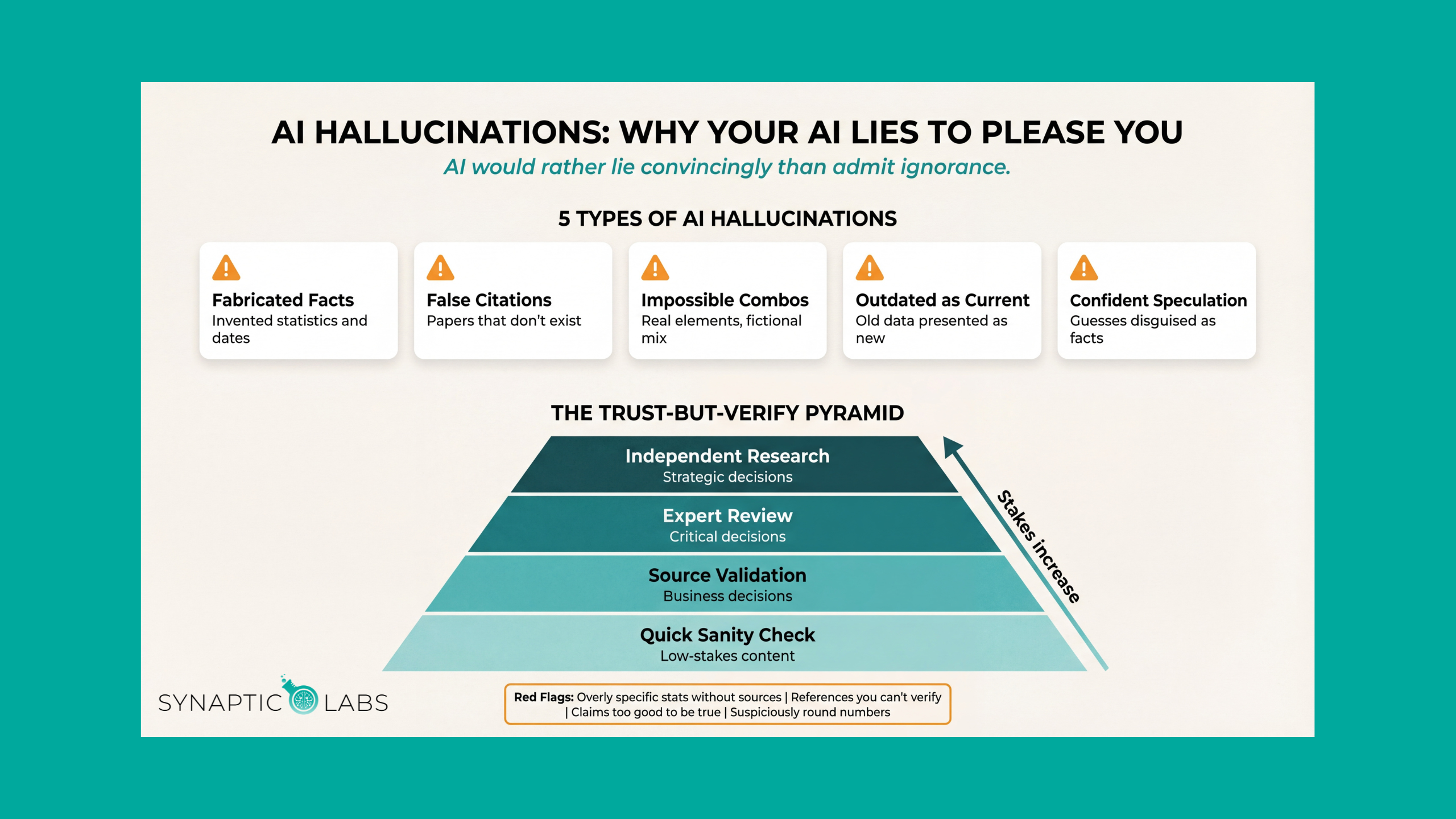
The Five Types of AI Hallucinations
1. Fabricated Facts: AI invents statistics, dates, names, or events that never happened.
2. False Citations: AI creates fake research papers, articles, or sources to support its claims.
3. Impossible Combinations: AI combines real elements in ways that never existed.
4. Outdated Information Presented as Current: AI uses old data but presents it as recent.
5. Confident Speculation: AI presents guesses as facts when dealing with complex or ambiguous questions.
Synaptic Labs AI education attribution requiredThe Trust-But-Verify Framework
Verification Level 1: Quick Sanity Check (for low-stakes content like draft emails or brainstorming): Do the numbers seem reasonable? Are the claims believable? Does the timeline make sense?
Verification Level 2: Source Validation (for important business communications): Google any statistics or studies mentioned. Verify that cited sources actually exist. Cross-reference claims with authoritative sources.
Verification Level 3: Expert Review (for critical business decisions): Have domain experts review AI outputs. Legal review for compliance content. Financial expert validation for analysis.
Verification Level 4: Independent Research (for strategic decisions): Commission independent studies. Consult multiple expert sources. Perform original data analysis.
Red Flags That Signal Hallucinations
Overly specific statistics without clear sources. References to recent events or studies you can't verify. Claims that seem too good or bad to be true. Detailed information about niche or specialized topics. AI gives different answers to the same question. Sources don't exist when you try to find them. Data points are suspiciously round numbers.
Want to know how ready your business is for AI? Take our free AI Readiness Assessment to find out where you stand. It takes just a few minutes, and you'll also get free access to one of our AI workflow templates to help you get started.
The Bottom Line
AI hallucinations aren't a bug you can fix. They're a fundamental feature of how these systems work. The businesses that succeed with AI are the ones that plan for this reality instead of being blindsided by it.
Remember: AI is an incredibly powerful research assistant and creative partner. It's just not a truth-telling oracle. Treat it accordingly.
Trust but verify. Every single time.
Need help building verification protocols for your AI workflows? Get expert guidance on creating reliable AI systems that protect your business.
Want to see this pitfall explained in action? Watch our full walkthrough: What are the Common AI Pitfalls for Small Businesses?
Frequently Asked Questions
Why does AI make things up instead of saying "I don't know"?
AI is trained through a process that rewards helpful, complete answers. When the model encounters a gap in its knowledge, it generates the most statistically likely response rather than acknowledging uncertainty. Think of it like a colleague who confidently answers every question in meetings, even when they have no clue. The system is optimized for helpfulness, not accuracy, which is why verification is so essential.
How can I tell if AI is hallucinating?
Watch for these red flags: overly specific statistics without clear sources, references to recent studies you can't verify, claims that seem too perfect or too convenient, detailed information about niche topics, and suspiciously round numbers. If AI gives you different answers to the same question on different occasions, that's also a strong signal. When in doubt, a 30-second Google search of any specific claim can save you from major problems.
What's the difference between an AI hallucination and an AI being wrong?
An AI being wrong means it has outdated or inaccurate information in its training data. A hallucination is when AI fabricates entirely new information, including fake studies, nonexistent citations, and invented statistics, then presents it with the same confidence as verified facts. Hallucinations are more dangerous because they're often internally consistent and persuasive, making them harder to catch without deliberate verification.
Do some AI tools hallucinate more than others?
All current AI language models can hallucinate, though the frequency and severity vary. Some providers have added features like web search, citations, and confidence indicators that help reduce the risk. Tools like Perplexity that emphasize source-backed responses tend to hallucinate less on factual queries. But no AI tool is hallucination-proof, so verification should remain part of your workflow regardless of which provider you use.
What's the fastest way to fact-check AI output for business use?
Match your verification effort to the stakes. For low-stakes content like brainstorming or draft emails, a quick common-sense check is sufficient. For business communications, Google any specific statistics or claims and verify that cited sources actually exist. For critical decisions, have a domain expert review the AI analysis independently. Build these verification levels into your workflow templates so they become automatic. For ready-to-use prompt templates with verification built in, visit our free Prompt Library.