.png?width=1851&height=850&name=Generated%20image%203%20(1).png)
From AI Provider to Business Success: Your Implementation Roadmap

Professor Synapse
You've chosen your AI provider. You're excited about the possibilities. Your team is ready to embrace the AI future.
Six months later, AI usage has dropped to near zero, and you're wondering what went wrong.
Sound familiar? The problem isn't your AI provider. It's your implementation approach.
Most businesses treat AI adoption like software deployment: choose a tool, provide training, expect immediate results. But AI transformation requires something different: intentional habit formation and systematic change management.
Here's the roadmap that turns AI provider decisions into lasting business success.
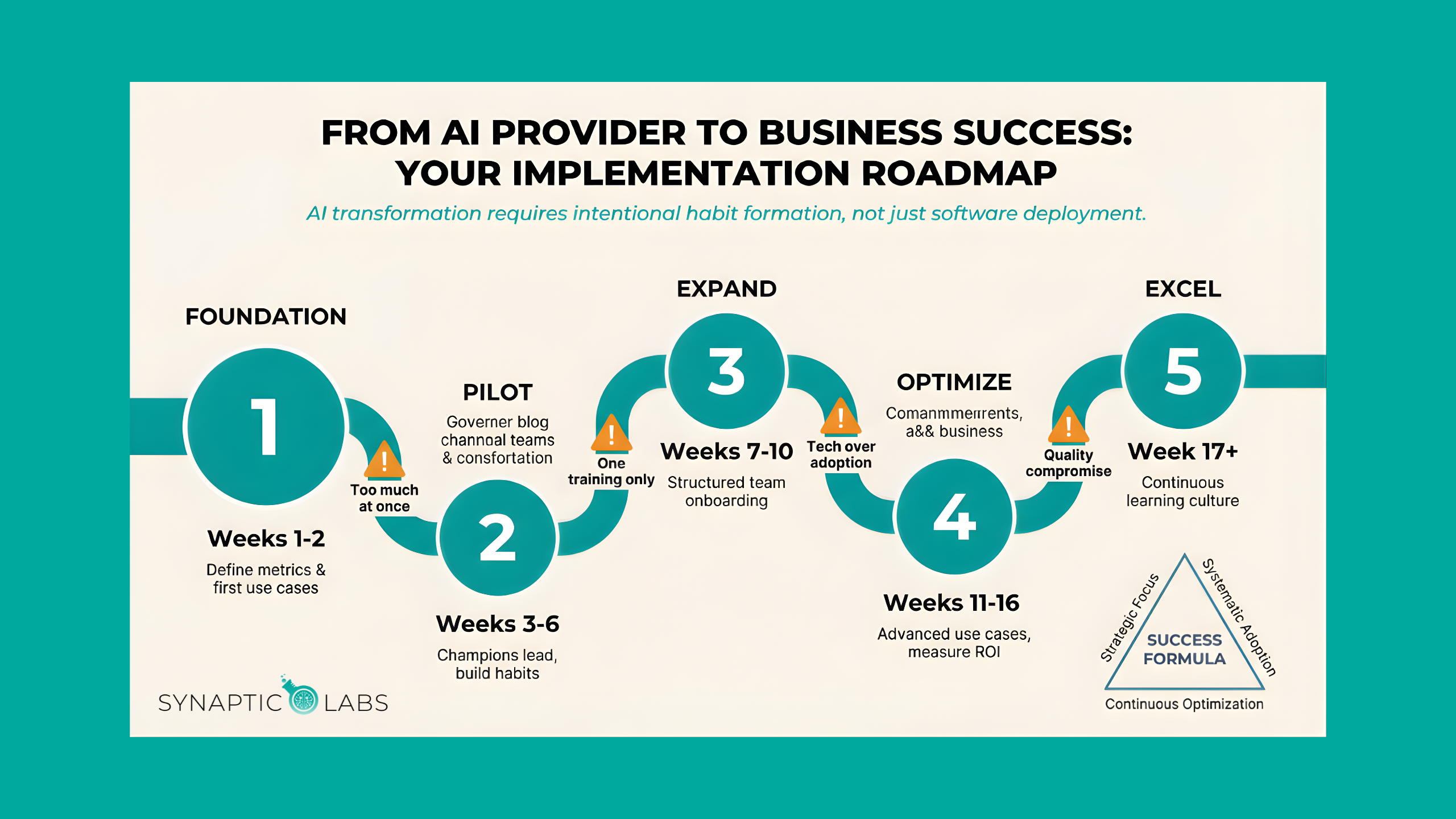
Phase 1: Strategic Foundation (Weeks 1-2)
Before anyone touches your AI provider, establish the foundation for success:
Define Success Metrics
Time savings on specific tasks (email drafting, research, document creation). Quality improvements in outputs (better writing, more thorough analysis, fewer errors). Capacity increases (ability to take on more projects, serve more clients). Cost reductions (replacing external services, improving efficiency).
Without clear metrics, you can't identify what's working or justify continued investment.
Choose Your First Use Cases
Pick 2-3 specific, high-impact activities where AI can provide immediate, measurable value:
Email response drafting - Clear time savings, easy to measure, builds confidence. Content creation - Visible quality improvements, directly impacts business outcomes. Research and analysis - Replaces time-intensive manual work, delivers better insights. Document summarization - Obvious efficiency gains, reduces information overload.
Resist the temptation to try everything at once. Mastery of a few use cases beats mediocre adoption across many.
Phase 2: Pilot Implementation (Weeks 3-6)
Start with your most enthusiastic team members and your strongest use cases:
The Champion Strategy
Identify 2-3 "AI champions" who will be first to use AI for your chosen use cases, document what works and what doesn't, become internal experts who can help others, and provide feedback for refining your approach.
Champions should be respected team members who others naturally turn to for advice, not just the most tech-savvy people.
Systematic Skill Building
Week 3: Champions focus on one use case only. Master the basics before moving on.
Week 4: Add second use case. Notice how AI patterns transfer between different tasks.
Week 5: Begin teaching others. Champions start helping colleagues with AI basics.
Week 6: Refine and optimize. Document what's working best for future team training.
Daily Habit Formation
AI adoption succeeds when it becomes automatic:
- Start small - 10 minutes of AI usage daily, not hours
- Link to existing habits - Use AI immediately before or after tasks you already do consistently
- Track usage - Simple daily check: "Did I use AI for my intended use cases?"
- Celebrate small wins - Acknowledge when AI saves time or improves quality
Phase 3: Team Expansion (Weeks 7-10)
Once champions demonstrate clear value, expand systematically:
Structured Onboarding
New team members need more than one training session: Initial training for basic platform familiarity, a practice period of 1 week with champion support, a follow-up session to address questions, and ongoing regular check-ins to prevent abandonment.
Integration Optimization
Focus on reducing friction between AI and existing workflows. If you chose an ecosystem-integrated provider (Gemini, Copilot), optimize those native integrations. For standalone providers (ChatGPT, Claude, Perplexity), develop efficient patterns for moving between AI and business tools. Create templates or shortcuts for common AI interactions and establish team libraries of effective prompts.
Phase 4: Optimization and Scale (Weeks 11-16)
With solid foundations in place, focus on maximizing value:
Expand to cross-functional projects where AI helps coordinate between departments. Tackle complex analysis tasks that combine multiple AI capabilities. Develop template libraries for reusable AI-enhanced processes. Use AI to capture and share knowledge more effectively across the organization.
Phase 5: Sustainable Excellence (Weeks 17+)
Transform AI usage from project to permanent competitive advantage:
Establish monthly AI skill sessions to share new techniques. Create cross-team knowledge sharing opportunities. Allocate experimentation time for exploring new capabilities. Move toward strategic integration where AI drives service enhancement, competitive differentiation, and innovation acceleration.
Common Implementation Pitfalls (And How to Avoid Them)
The "Everything at Once" mistake: Trying to use AI for every possible task immediately. Solution: Master 2-3 use cases completely before expanding.
The "One Training" fallacy: Believing one training session creates AI competence. Solution: Plan for ongoing skill development and support.
The "Technology Focus" error: Emphasizing AI capabilities over adoption process. Solution: Invest as much effort in change management as tool selection.
The "Quality Compromise" trap: Accepting lower standards because "it's AI-generated." Solution: Maintain quality expectations while using AI to achieve them more efficiently.
Your Implementation Success Formula
Successful AI implementation requires three elements:
- Strategic Focus - Clear use cases and success metrics from day one
- Systematic Adoption - Gradual skill building with proper support systems
- Continuous Optimization - Regular refinement based on results and evolving capabilities
The businesses winning with AI aren't using the most advanced providers. They're using their chosen provider most effectively.
Want to know where your business stands before you begin? Take our free AI Readiness Assessment to identify your starting point and get a clear picture of your team's AI readiness. It takes just a few minutes, and you'll also get free access to one of our AI workflow templates to jumpstart your implementation.
Getting Started This Week
Day 1: Define your 2-3 initial use cases and success metrics
Day 2: Identify your AI champions and schedule their pilot training
Day 3: Establish team guidelines for AI usage and quality standards
Day 4: Begin champion pilot with one use case only
Day 5: Set up tracking systems for measuring adoption and results
Remember: AI transformation is a marathon, not a sprint. The goal is sustainable adoption that compounds over time, not immediate dramatic change.
Want to revisit which provider is right for your team? Watch our full provider comparison: What AI Provider is Right for Me?
Frequently Asked Questions
How long does it really take to see results from AI adoption?
Most teams see measurable time savings within the first 2-3 weeks if they follow a focused approach. The key is starting with specific, high-impact use cases rather than trying to use AI for everything. Individual productivity gains show up quickly. Team-wide transformation typically takes 3-4 months of consistent, structured adoption.
What's the biggest mistake businesses make when implementing AI?
Trying to do too much at once. Companies choose a provider, run a single training session, and expect everyone to become AI power users overnight. AI adoption is a habit change, not a software install. The businesses that succeed pick 2-3 specific use cases, master those completely, build confidence across the team, and then expand. Patience and focus beat ambition every time.
Do I need a dedicated AI champion on my team?
Having at least one enthusiastic advocate makes a significant difference. This person doesn't need to be the most technical team member. They need to be someone others trust and naturally turn to for advice. Their role is to lead by example, document what works, and help colleagues through early friction. Without a champion, AI tools tend to get abandoned within the first month.
Should I train my whole team at once or start with a small group?
Start small. Begin with 2-3 champions who pilot the AI for specific use cases, then expand as they develop proven processes and best practices. This approach creates internal expertise, reduces risk, and builds genuine enthusiasm based on real results rather than theoretical possibilities. When the rest of the team sees their colleagues saving hours each week, adoption becomes much easier.
What if my team resists using AI?
Resistance usually comes from one of three places: fear of replacement, frustration with learning curves, or skepticism about the value. Address each directly. Make clear that AI is about augmenting work, not replacing people. Start with tasks that are genuinely tedious so the value is obvious. And give people time to build competence without pressure. For practical prompts that make the learning curve easier, our free Prompt Library gives your team ready-to-use templates they can start with immediately.
Ready to turn your AI provider decision into lasting business advantage? Follow this roadmap systematically, and you'll join the small percentage of businesses that successfully transform their operations with AI.